
Black and White
In the 1930s and 1940s cost was not the only factor deciding which film produce a film project would employ. Hollywood Technicolor tended to be employed to make everything notable so that the most serious dramas often performed to be black and white, the complete genre of film noir, and so on.It’s extremely essential to remember that black and white can be just as definite as colour because we can produce so many elements to it. First, black and white are never just that: It is also all the scales of grey in between. And silver. And beiges. And so on.Black and white is the tone of glamour cinematography. The most glamorous icons of the screen,And, at least one whole film genre is established in large part by the fact that it was shot in black and white: film noir.Directors still sometimes opt for black and white to make a legislative and/or aesthetic point. Some films are shot in black and white as a kind of tribute to earlier cinema genres.Especially for the Technicolor technicians, the primary job was to figure out how to produce colour film fair to an audience and an industry that was at first reluctant about the technology.Some directors have been thinking outside the Crayola box, mixing panchromatic and colour stock in the same film. Early on the resolution was in part economic: Technicolor was especially expensive. But even early on the decision to merge it up could be caused by plot and theme as much as by economics.
HOW ARE BLACK AND WHITE USED IN TODAY’S FILM

Ever since the arrival of color photography, the past has been portrayed as in black and white, sepia tone, or softened colors. Normally invoked for a Flashback or silent film tribute. Sometimes caused fun of by declaring that the real world was, in fact, black and white preceding to the invention of color.
LETTER BOX

Letter boxing is the method of transferring film shot in a widescreen aspect ratio to standard-width video formats while conserving the film’s primary aspect ratio. The resulting video graphics image has (black bars) above and below it; these boxes are an element of the image.The first application of letterbox in consumer video emerged with the RCA videodisc format. Originally, letterboxing was restricted to several key progressions of a film such as opening and closing credits later employed for entire films. The first fully letterbox release was Each disc includes a label noting the use of RCA’s innovative wide-screen mastering procedure.
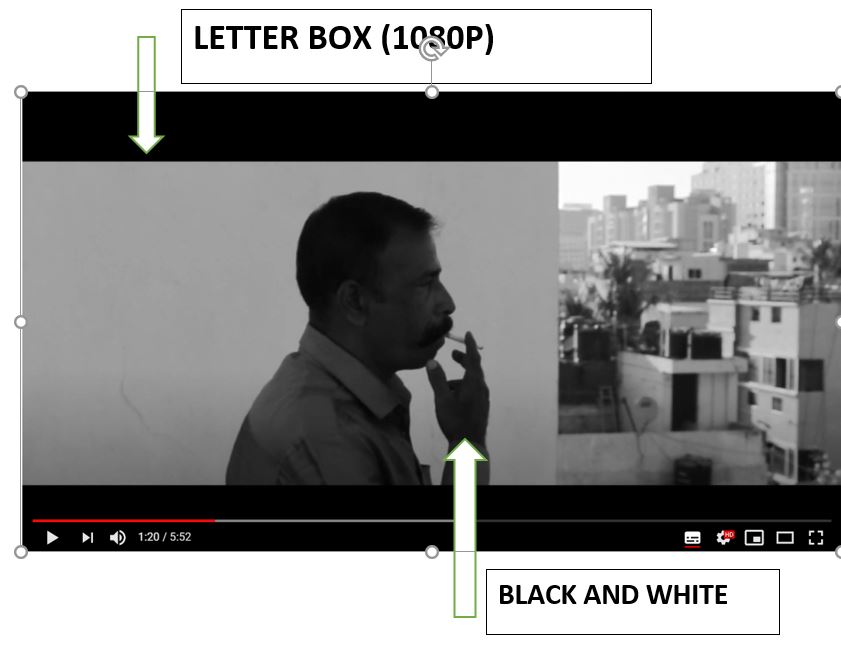
IRANDU DISAIGAL implements these two prospects. As it is a 1080p film with the resolution of 1920×1080 it equips 1080 letterbox and black and white because to explicate the differences of present and past. Black and white colour grading have been equipped, besides, that’s how the audience would conjecture about the narrative line as well as distinguish them.

